
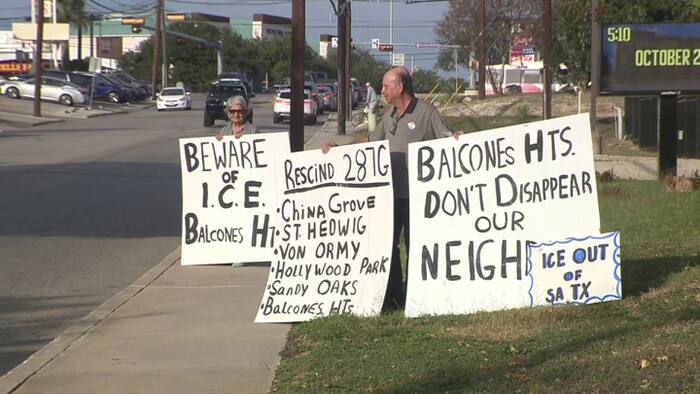
On Monday, the City of Balcones Heights did not come to a final decision on whether it would consider rescinding its partnership with U.S. Immigration and Customs Enforcement under the federal 287(g) program.
Hours before that discussion began, community members and advocates gathered outside Balcones Heights City Hall on Monday evening, urging city leaders to reconsider the city’s participation.
The demonstration included Rebecca Flores, who leads the Bexar County Democratic Party’s Immigration Committee, Texas Sen. Jose Menendez and dozens of other community members outside the building on Hillcrest Drive.
The gathering follows an August call to action from state and federal lawmakers who urged six Bexar County cities to reconsider their partnership of the 287(g) agreements with ICE. Balcones Heights was among the cities named, along with China Grove, Hollywood Park, St. Hedwig, Sandy Oaks and Von Ormy.
Under the 287(g) Task Force Model, trained and authorized local officers can perform certain immigration enforcement duties while carrying out routine police work, under ICE oversight. ICE said the program is intended to strengthen cooperation between federal immigration authorities and local law enforcement.
Flores said she worries the agreement could affect residents’ trust in local police, particularly among people who fear being questioned about their immigration status.
“This is so harmful to their community,” Flores told KSAT during an interview. “Eighty percent of the people that live here in Balcones Heights are minority.”
Flores also expressed concern about immigration detention and the potential effects on families.
Menendez also called on city leaders to end the agreement, arguing that it could discourage people from visiting businesses or reporting crimes.
“I think it’s going to really be a huge deterrent,” Menendez said. “I think it’s a mistake. I think they should stop.”
Menendez’s office is located at Wonderland of the Americas, a property owned by the city of Balcones Heights. He said he may reconsider his lease if the city continues with the agreement.
“I cannot be in a city that allows its law enforcement to become immigration officers,” Menendez said.
The financial incentives available to participating agencies were another concern raised during the demonstration.
According to the U.S. Department of Homeland Security, eligible agencies participating in the 287(g) program may qualify for reimbursement for certain officer salaries, benefits and overtime, along with equipment and technology stipends. The funding available depends on program requirements and qualifying enforcement activities.
Adam Castillo, a resident advocate, said he hopes city leaders will weigh the community’s concerns when considering the financial benefits.
“Hopefully the council will listen to us and side with us instead of the money,” Castillo said.
Other community members also spoke during the City Council meeting, echoing the words of Flores and Menendez.
KSAT attempted to speak with the Balcones Heights mayor and other City Council members during Monday evening’s meeting but was unable to do so. We also requested a written statement from the City of Balcones Heights.
Our newsroom also reached out to the six Bexar County cities identified in the August appeal. As of Monday evening, their decisions to work with federal immigration authorities had not changed.
A request for response was also submitted to U.S. Reps. Marc LaHood, Carrie Isaac, and Chip Roy during the August call to action and prior to Monday night’s council discussion. Our team has not heard back from their offices.
The debate continues over how local police should work with federal immigration authorities and how those partnerships affect public safety, community trust and local resources.
For more information, visit ICE’s 287(g) program page or read KSAT’s previous report on the lawmakers’ request.


